


Why Do Winter Shawls Cling to Clothing in Dry Weather?
A return marked “sticks to my coat” leaves an important part of the complaint outside the parcel. The coat is missing. So is any reading of the air where the shawl was worn. By the time the parcel is opened, the circumstances of the original observation have gone. Winter shawl buyers need to recover those missing conditions. A finish selected against showroom clothing could still disappoint against the missing coat.
Can the Free Corner Move Away?
Find a loose corner and lift it just clear of the underlayer. Film what happens on release. Watch the cloth around that corner. Movement back across the open gap is unlike a fringe strand hanging from one identifiable loop. Listen as well, though silence offers no assurance that the surface is uncharged.
Look at the Contact Area Before Treating the Fabric
A rough knit can hold a raised shawl face mechanically. A smooth lining may hold the panel without any identifiable snag. Inspect the underside and fringe roots to establish whether a physical catch is present. A corner retained by a fastening gives the sewing or styling review a definite location to examine. If a broad panel repeatedly returns after being lifted clear, an electrostatic comparison becomes more useful.
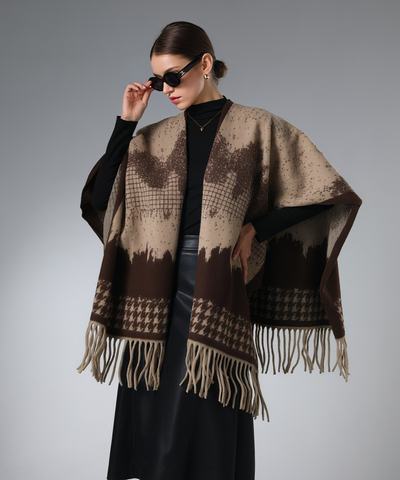
Record any belt, tuck, or wrapping turn that restricted the panel. Those restraints can hold a panel against clothing without any charge. Open the wrap and that restraint disappears. The polyester shawl collection shows several coverage arrangements worth distinguishing during sample review. None of those photographs supplies the missing contact fabric from a return.
How Can the Attraction Outlast the Movement?
Charge may remain on surfaces that have just separated. In a worn outfit, sleeve movement supplies many such separations; removing the article from its bag supplies others. Some charge can leak away through moisture associated with the surfaces. Drier surfaces offer less help with that leakage. Attraction may then be visible for a while after rubbing has ceased.
Condition the Lining Alongside the Shawl
“Tested in the same room” leaves a gap if one item came straight from a warm cupboard and the other from storage. The lining needs conditioning too. Condition both pieces by the agreed procedure. Record the trial location’s temperature and relative humidity, then retain that environment for the intervals between repetitions. The conditioning procedure belongs with the result.
Composition helps with interpretation. For wool, moisture-vapor uptake affects electrical behavior without guaranteeing the finished wrap’s response. Panel weight and flexibility also matter to the observation: a force may visibly move light cloth while leaving a heavier construction relatively still. Different polyester constructions can consequently look quite different during the same trial. A fiber ranking cannot replace observation of those panels against the intended clothing.
How Can Buyers Reproduce the Reported Cling?
Keep an unused production piece and the approved sample beside the returned item. First compare them against the same identified garment or retained contact fabric. Choose a defined area and face for the movement. Note where each piece rests between repetitions. An unrecorded contact with a chair or a handler is another opportunity to alter the charge before the observation.
Keep the Shawl and Exchange the Underlayer
Begin with the reported lining or sweater. Then repeat with a second identified contact fabric while holding the room conditions steady. A different ranking against the second surface shows why a supplier cannot promise the same behavior with every outfit. By contrast, a similar shift across all pieces after a humidity change draws attention to conditioning. Preserve both observations; the hanging appearance alone would conceal how the response changed.
|
Comparison |
Observation worth retaining |
|
Same contact fabric, different shawls |
Whether production differs from the approved reference. |
|
Same shawl, different contact fabrics |
Whether the clothing combination changes the response. |
|
One fabric pair at two recorded humidity conditions |
How much the response changes with atmospheric moisture. |
|
Before and after permitted care |
Whether laundering or finishing history changes the result. |
Choose the observation before starting the camera. For one trial the useful feature may be release time; for another it may be the extent of attached cloth or whether it returns across a gap. Keep that choice consistent through the comparison. Mark the viewing position and keep the entire movement in frame. A room described as “winter conditions” is too vague to reproduce, and an invented universal passing time would add false precision.
What Does a Laboratory Cling Result Actually Cover?
The contact surface in AATCC TM115 is metal. The method concerns relative clinging caused by electrostatic charge, with the influence of fabric characteristics included in that response. That makes it a possible laboratory reference, but its metal contact is different from a customer’s coat lining. A report using this method should retain the named edition, conditioning, specimen details, and result; an outfit simulation should be identified separately.
Check the Care State Before Approving a Finish
With a proposed antistatic finish, retain an otherwise comparable untreated piece. Without that control, a different fabric batch could be credited as a treatment improvement. Then repeat after the intended care route. A temporary improvement straight from finishing does not establish the behavior customers will see later. Check shade and handle beside the original approval, and look for transfer to the underlayer. Keep sprays and household softeners off the received complaint piece until its original state has been documented.
These checks can sit alongside a woven shawl specification, but a general construction category is not an antistatic claim. The order needs a reference sample and a defined comparison relevant to the expected clothing and climate.
What Should Be Agreed Before Approving a Winter Shawl Sample?
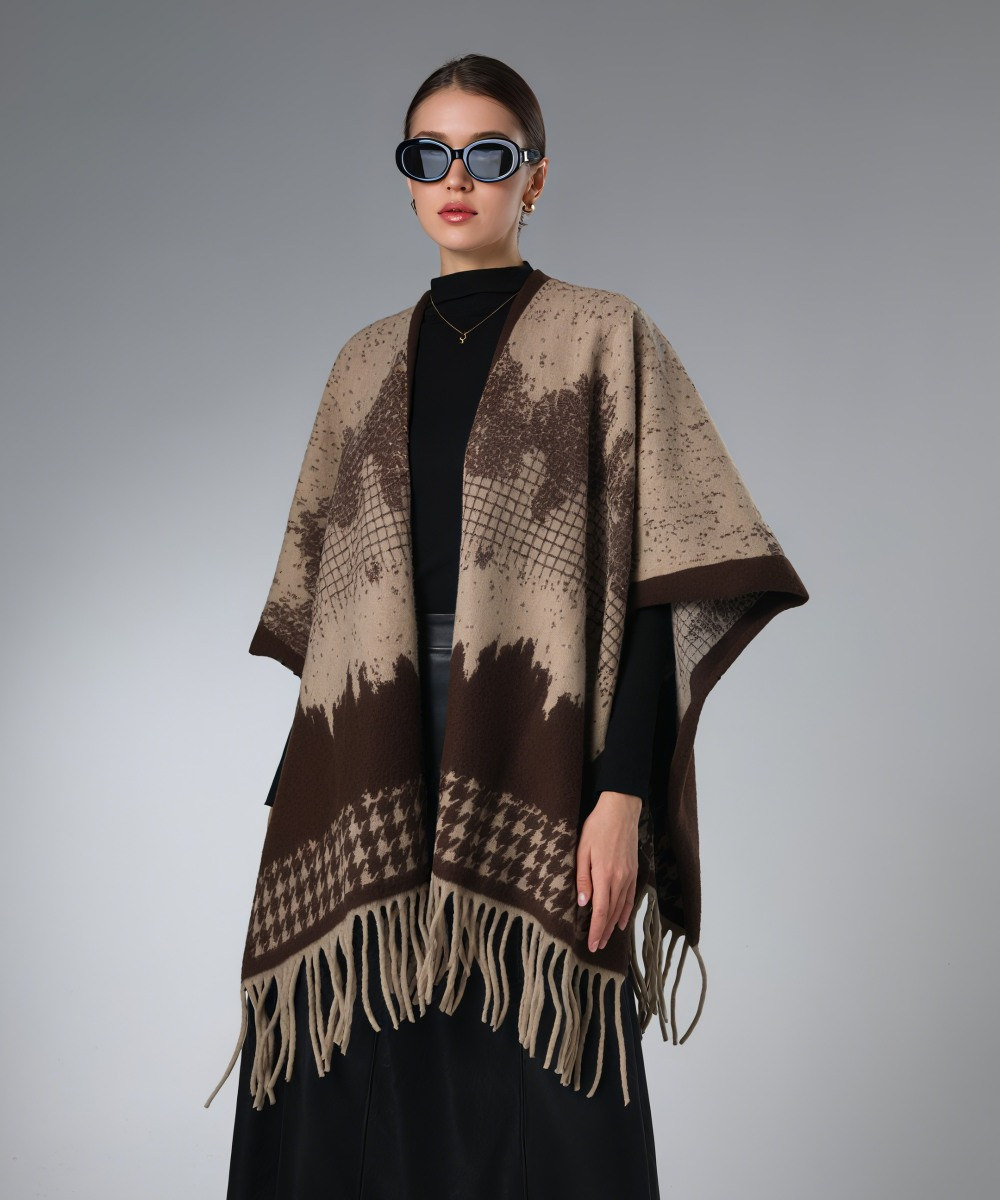
A winter sample discussion with Sie glaubt can begin with the proposed clothing combination. The listed Winter Schal Wrap Braun Houndstooth Schal mit Fringe provides a woven polyester reference for autumn and winter; its page contains no order-specific static-cling measurement. The ODM- und OEM-Service provides a route to settle which contact cloth, conditioning procedure, care state, and sample will govern approval. Any treatment or performance claim should be confirmed for that specific construction before the bulk order is released.
Schlussfolgerung
A shawl examined on its own leaves the contact side of a cling complaint unanswered. Recover the clothing and conditioning history so the production piece can be compared fairly. Once hooking has been separated from attraction, the same comparison can be run on the return, an unused lot sample, and the approval piece. Laboratory evidence and a recorded clothing trial can then answer their respective questions. The retained comparison can accompany the correction through sampling, so its effect remains observable.
Häufig gestellte Fragen
1. Is a cling complaint enough to reject a lot?
No. The observation includes the underlayer and the air around it. A lot decision needs evidence that the supplied article differs from the approved reference or fails the agreed requirement under comparable conditions.
2. Can a fabric-to-metal result replace a coat trial?
It provides evidence under its own method. It does not reproduce every lining, sweater, or wearing arrangement, so a relevant project trial may still be needed.
3. Should a returned shawl be sprayed before inspection?
Preserve its received condition first. After spraying, the examiner can no longer observe the untreated surface as received. Use separate identified specimens for any treatment comparison.


