How to Develop a Reversible Scarf Collection for Two-in-One Styling
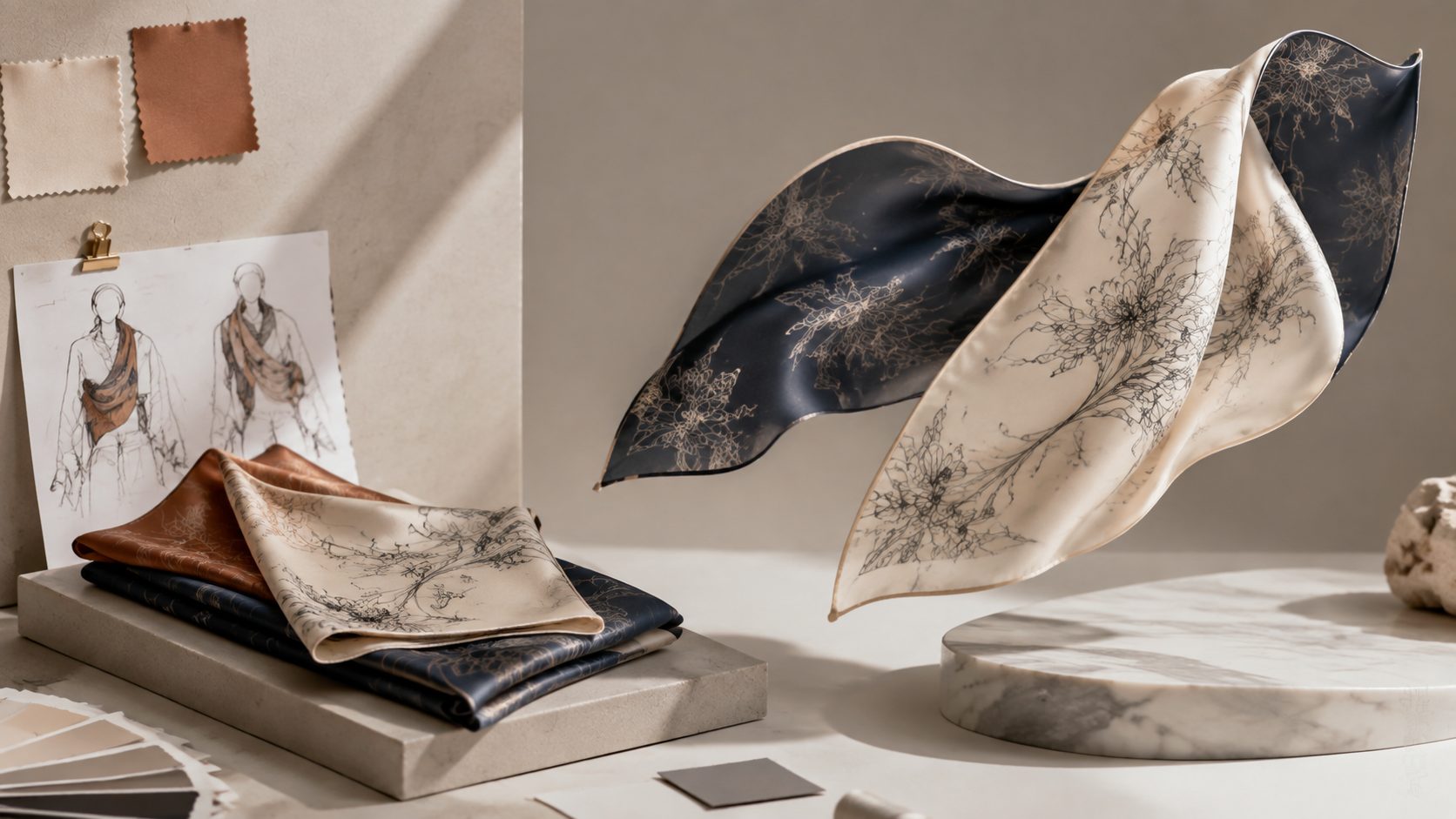
A reversible scarf collection works when both sides feel intentional, not when a second surface is added simply so the product can be called “two-in-one.” For fashion brands, product developers, and sourcing managers, the real work starts with deciding how Side A and Side B relate, how the scarf will look once folded, and whether the chosen construction can reproduce that idea consistently in bulk. Material, pattern placement, dimensions, finishing, color control, MOQ, and sample approval all need to be settled before production. Buyers developing a wider scarf collection should therefore treat reversibility as a product specification rather than a styling claim.
What Should Be Defined Before a Reversible Scarf Goes to Sampling?
Start with the wearing experience. A buyer should be able to explain what changes when the scarf is flipped.
Side A might carry the stronger print while Side B uses a quieter coordinated pattern. Another collection may pair two solids, or use related motifs in contrasting colors. What matters is that each side can stand on its own.
Design Side A and Side B as a pair
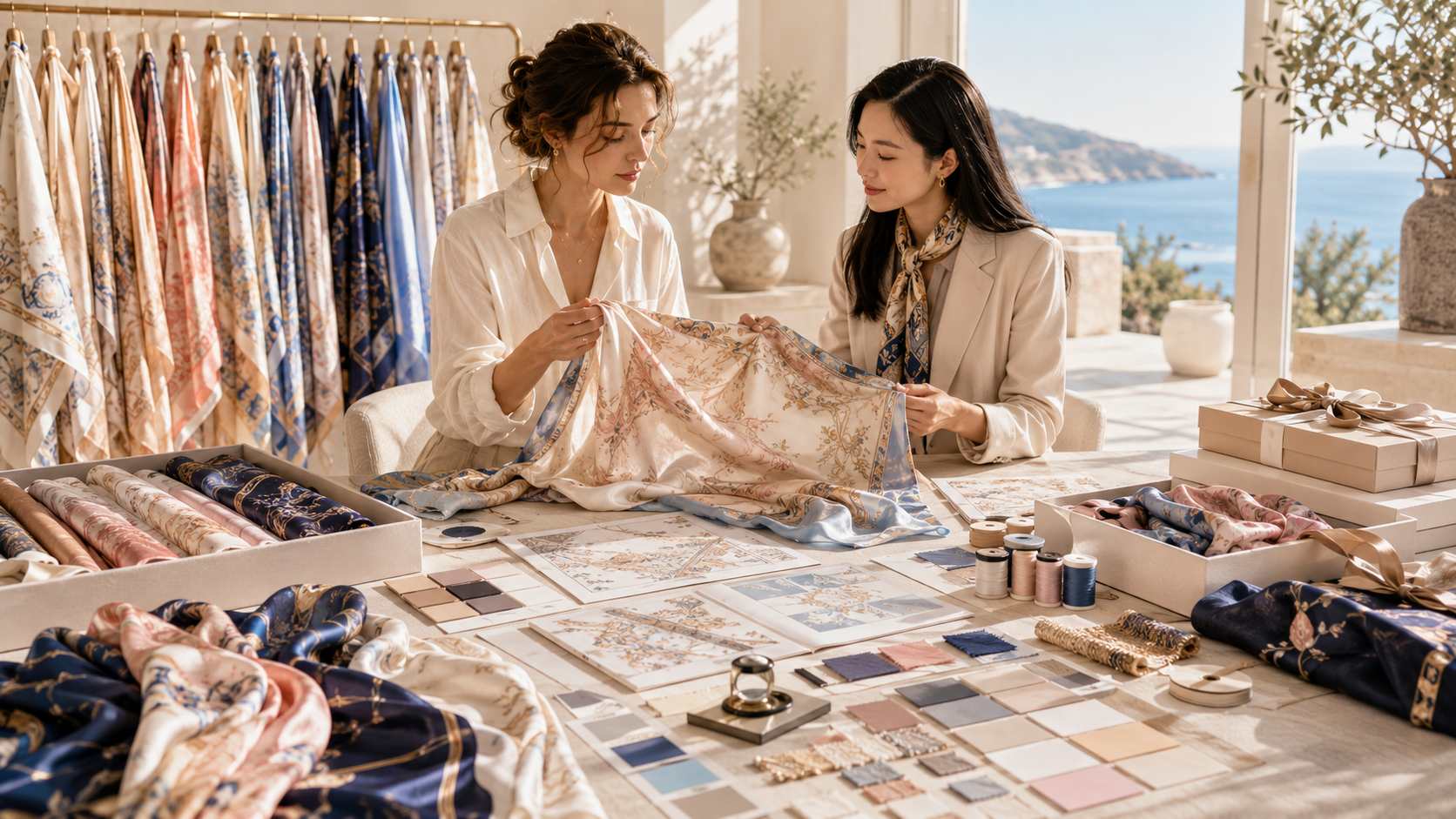
Do not approve the two surfaces separately and assume they will work together later. Put them on the same development sheet. Record the dominant color, secondary color, motif direction, logo position, edge treatment, and intended styling view for each side.
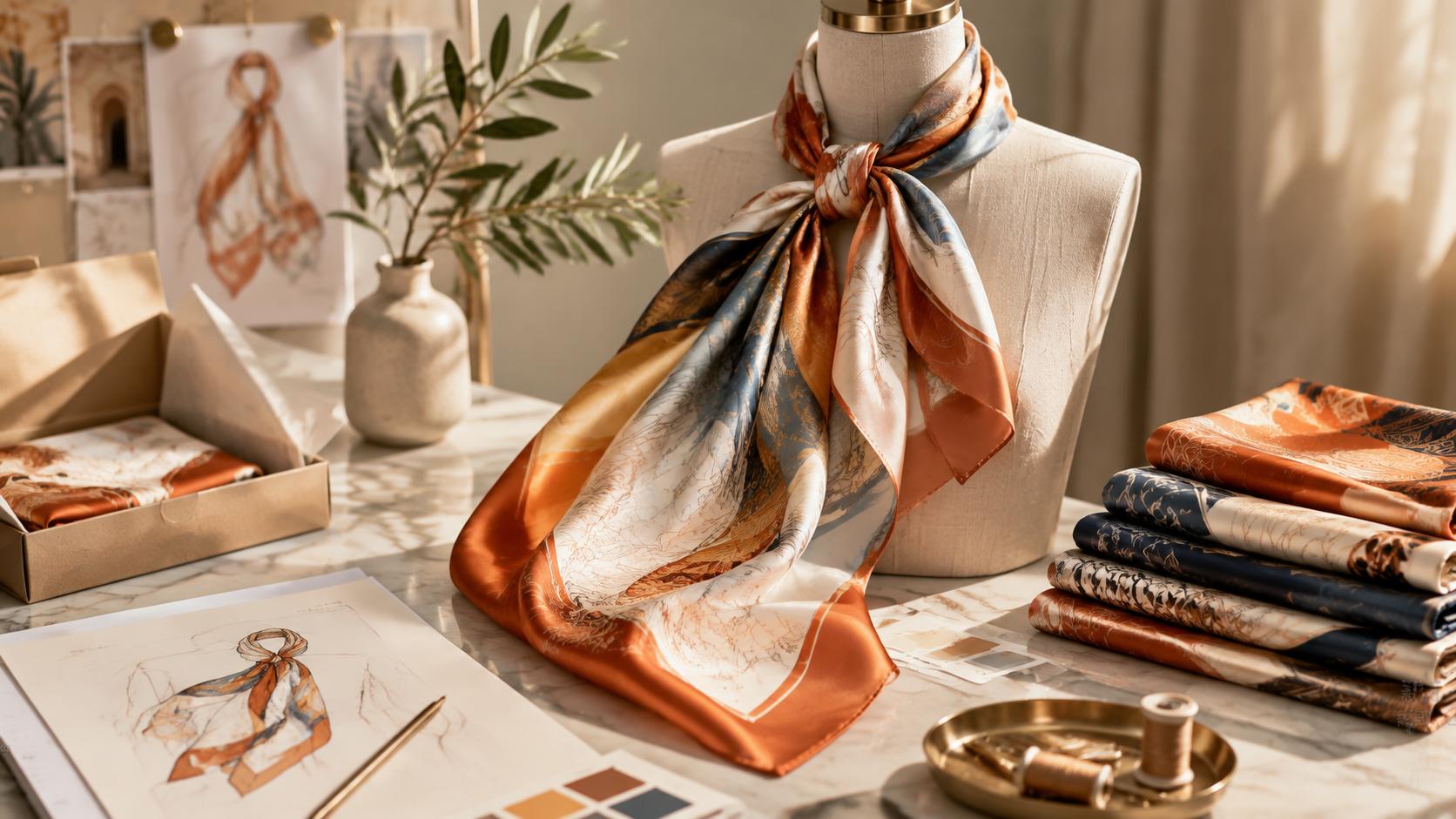
Then test the design in folded form. Large artwork can look balanced on an open scarf and virtually disappear when the scarf is wrapped around the neck. Border details may become much more visible than the center. This is especially important if the two sides are intended to create noticeably different outfits.
A useful brief can look like this:
| Development item | What the buyer should specify | What to check on the sample |
|---|---|---|
| Side A | Main color, motif, logo position | Does the intended motif remain visible when worn? |
| Side B | Contrast or coordinated design | Does it look complete without Side A showing? |
| Dimensions | Finished length and width | Is the proportion right for intended tying methods? |
| Edge | Fringe, stitched edge, or other approved finish | Is the finish even on both faces? |
| Branding | Woven label, care label, logo treatment | Does branding interfere with reversibility? |
| 包装 | Fold direction and presentation | Can customers immediately understand the two-sided feature? |
The last point is easily missed. If customers cannot tell that the scarf is reversible when they first see it, much of the commercial value of the design disappears.
Which Material and Construction Should a Buyer Choose?
There is no single construction that should be applied to every reversible scarf. The supplied product information covers knitted, woven, embroidered, printed, and other scarf and shawl processes, so the right route depends on the artwork, hand feel, season, price position, and appearance required on each face.
Use an existing product as a specification reference, not a universal standard
The current ペイスリー&リーフリバーシブルシャールデュアルユーズスカーフ is a useful example of how a reversible concept can be written into measurable specifications. The website lists a 65% polyester fiber and 35% adhesive-fibre composition, a double-sided paisley-and-leaf design, an autumn/winter positioning, and a warp process. It also provides finished dimensions, MOQ, and delivery information. Those figures belong to that particular item rather than every custom reversible project.
This distinction matters during RFQ comparison. “Reversible scarf” is not enough for two factories to quote the same product. Buyers should ask both suppliers to quote against identical material composition, dimensions, weight or construction, artwork, finishing, labels, packaging, and quantity.
For cold-season programs, comparing the planned item with the brand’s broader winter scarf assortment can also help prevent a reversible style from becoming an isolated SKU with no connection to the rest of the collection.
How Can Brands Build a Reversible Collection Without Creating Too Many SKUs?

Reversibility already gives one physical product more styling possibilities. That advantage can be lost if the range contains too many colors and pattern combinations.
The collection should have a visible system.
Build combinations around roles, not random colorways
One scarf can act as the commercial core: perhaps a neutral paired with another neutral. A second can introduce the seasonal color story. A third may carry the strongest graphic treatment.
That does not mean every brand needs three designs. It means every design should have a job.
Before sampling, map the collection in a simple matrix:
| Style role | Side A | Side B | Intended buyer reason |
|---|---|---|---|
| Core | Easy-to-match tone | Second neutral | Broad wardrobe use |
| Seasonal | Seasonal color | Coordinating basic | Adds novelty without losing wearability |
| Statement | Strong motif | Quieter reverse | Two visibly different styling moods |
This table is a planning model, not a She Believes MOQ requirement. The final number of designs should follow the brand’s sales plan and the supplier’s actual order terms.
The same logic applies to dimensions. A reversible shawl, a narrow neck scarf, and an oversized wrap solve different styling problems. Do not change both dimensions and artwork across every SKU unless the commercial plan truly needs that variety.
Brands still developing their technical brief may also find the factory-communication approach in this guide to briefing a scarf factory useful before sending the first RFQ.
What Should Buyers Inspect on a Reversible Scarf Sample?
A reversible sample has one extra risk compared with a conventional scarf: defects that would normally sit on the “back” may now be visible.
That changes the approval process.
Inspect both surfaces under the same standard
Lay the scarf completely flat and inspect Side A. Then turn it over and repeat the same process on Side B. After that, fold and tie it in the ways shown in the product brief.
Check color consistency, pattern position, dimensions, surface appearance, edge finishing, labels, loose threads, and the transition between the two faces. If the product includes fringe or tassels, look at how those details appear whichever side faces outward.
Branding needs special attention. A large care label placed without thought can immediately announce which side is supposedly the “back.” If the commercial promise is true two-way wear, the label solution needs to be considered during development rather than after production.
The supplied company documentation describes quality control at raw-material, in-process, and finished-product stages. For custom buyers, the practical step is to turn the approved sample into the reference standard. Comments such as “make it softer” are difficult to inspect against later. Recorded dimensions, approved colors, confirmed artwork, finishing details, and physical samples are much easier to control.
How Should MOQ, Lead Time, and Cost Be Discussed With the Factory?
The buyer should ask for terms against the completed specification, not against the word “scarf.”
Material, dimensions, pattern process, branding, labels, packaging, and total quantity can all affect custom-order requirements. A lower MOQ on one construction does not automatically mean the same MOQ applies after a new yarn, complicated artwork, special packaging, or another finishing step is added.
The website’s reversible paisley-and-leaf item, for example, currently lists an MOQ of 300 pieces and a delivery time of 15–20 days. Again, those numbers describe that product and should not be treated as a blanket quotation for a new collection.
A buyer comparing development routes should therefore ask the supplier to separate sample requirements, production MOQ, unit price, packaging cost, and expected production schedule.
The development model matters as well. If your team already owns the finished artwork and technical specifications, OEM may be appropriate. If the collection still needs help with product interpretation, material matching, or design development, ODM support may fit better. The differences are discussed in more detail in OEM vs ODM Scarf Manufacturing: Which Is Better for Your Brand?.
Who Can Support Reversible Scarf Development?
彼女は信じる develops custom scarves, shawls, and related fashion accessories for B2B buyers. Its documented capabilities cover OEM and ODM development, material matching, sampling, multiple textile processes, custom labels and packaging, and quality inspection through production. The current website also includes reversible products and describes reversible stoles among its accessory capabilities.
For a new reversible program, the most useful first inquiry is not simply “What is your price?” Send the intended material, dimensions, Side A and Side B artwork, estimated order quantity, target launch date, label requirements, and packaging expectations. That gives the supplier enough information to judge feasibility and quote the same product your team actually intends to buy.
結論
A reversible scarf collection should create extra styling value without doubling development confusion. Define the two faces together, choose a construction that suits the visual brief, keep the SKU architecture disciplined, and inspect both surfaces as finished faces. Most importantly, freeze measurable specifications before bulk production.
For sourcing teams, the next step is straightforward: prepare one development sheet showing both sides of each proposed style, add material, size, quantity, finishing, label, packaging, and launch requirements, and use that document for sampling and supplier comparison.
FAQについて
1. What makes a scarf genuinely reversible?
Both visible faces should be intentionally designed and suitable for wearing outward. Pattern placement, finishing, edges, labels, and construction should therefore be evaluated from both sides.
2. Should both sides of a reversible scarf use different patterns?
Not necessarily. Brands can use two patterns, two solid colors, or a statement side paired with a quieter reverse. The decision should follow the collection concept and the way customers are expected to style the item.
3. What should be included in a reversible scarf tech pack?
Include Side A and Side B artwork, dimensions, material, colors, pattern position, edge finishing, logo treatment, labels, packaging, intended wearing views, and order quantity.
4. Does a reversible scarf always have a higher MOQ?
Not automatically. MOQ depends on the actual material, process, size, branding, packaging, and supplier setup. Buyers should request terms after the complete specification is defined.
5. What is the most important QC step for reversible scarves?
Inspect both surfaces as finished faces and then inspect the scarf again in its intended folded and tied positions. The approved sample should remain the visual and technical reference for bulk production.