


How Should Buyers Evaluate Sequin Attachment Strength in Holiday Shawls?
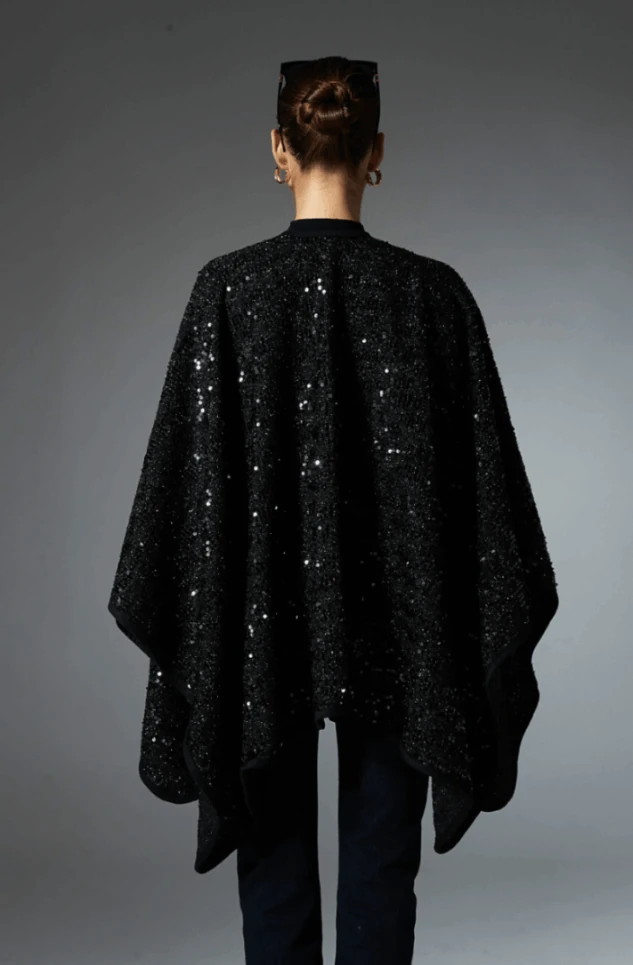
A loose sequin is easy to count. What matters next is whether the thread failed at that one spot or has begun releasing the rest of its route. One construction can lose a single disc and stop there. In another, the visible gap appears before neighboring pieces loosen. While the shawl is motionless, neither construction may show its weak point.
Approval is easier to interpret when the motif is viewed from the face and reverse together. The route of the thread and any strain around its holes show which part a test needs to challenge. A convenient limit taken from another decorated item cannot do the same job.
Where Does the Holding Thread Begin and End?
With an isolated stitch, a break may end at that disc; with a continuous row, it can loosen the next attachment. Within embroidery, that route may carry nearby decorative elements as well. Some decorations use bonding, where edge lift and care exposure become relevant. The construction on the approval sample, not the general product name, determines which failure can spread.
Trace One Attachment From Front to Back
Begin at a visible sequin and follow the thread through the cloth. The reverse side makes floats, backing, locks, and unfinished tails easier to distinguish. Then flex that small area. Widening holes or new puckers during flexing show that force is moving into the base cloth before the disc detaches.
Mark one motif and photograph that exact location from both faces. This prevents evidence from two different sections being paired as though it showed one attachment. Where a thread links several sequins, a separate development piece can show where the route stops after an intentional break and whether the looseness continues. The saleable approval piece need not be sacrificed for this.
An embroidery shawl collection can combine sewn decoration in several forms. Identify whether thread, backing, or another element supports the sequin instead of assuming that the category name answers it.
Where Will the Shawl Meet a Real Snag?
The quiet center of a flat motif may be convenient for a pull test, although it sees little of the handling that worries customers. Edges and fringe roots are grasped. Fold lines are pressed. Closures and arm movement bring other surfaces across the decoration. A cupped disc gives those surfaces a lip to catch, while a small flat disc may let them pass.
Recreate the Contact Around the Intended Outfit and Pack
A motif that passes over smooth fabric may catch on lace openings or coarse knit loops. Jewelry and hangers introduce hard edges; hook-and-loop trim and a neighboring sequined face create still other snag shapes. Move the development shawl through its expected dressing and packing sequence so those contacts reach the same areas they would in use.
The record can be brief but must make the run understandable: name the contacting material, note the repetitions, and say when the motif was checked. This is a project handling simulation. It should remain separate from any published standard.
What Can Make an Attachment Test Give the Wrong Answer?
A proof load and a pull to failure answer different questions. The first asks whether the attachment survives a chosen demand. The second reveals where the assembly finally gives way. Reporting a failure force after a proof check, or calling a destructive pull a pass test, blurs the meaning of the result.
Set the Fixture Around the Decoration, Not Around a Convenient Number
|
Control |
Project detail to settle |
|---|---|
|
Specimen |
Color, size, motif position, sequin type, and care state. |
|
Fixture |
How the sequin is engaged and how the nearby cloth is supported. |
|
Loading |
Direction, rate, duration, and proof or destructive purpose. |
|
Sampling |
Points chosen across edges, dense areas, and other risk zones. |
|
Failure |
The sequin leaves or shifts, the thread breaks, the cloth is damaged, or looseness reaches another attachment. |
A disc cut by the grip has failed at the fixture, so its result says nothing useful about stitch retention. Rigid support across a wide area suppresses local bending that would remain when only the cloth near the motif is supported. A perpendicular lift and a sideways catch also follow different load paths through the stitch. A force value without those fixture details is therefore incomplete.
The grab method in ISO 13935-2:2026 measures the maximum force at rupture of a sewn seam. It supplies no dedicated acceptance value for sequins. The same type of machine may apply a project-specific sequin load, provided grip, fabric support, direction, and endpoint are defined separately.
Did the Disc, the Thread, or the Cloth Give the First Warning?
Initial evidence might be an empty position, a disc turned out of line, a crack, or a worn finish. A disc may still cover its position even though the crossing thread has gone slack. In a different failure, the stitch survives but pulls the surrounding cloth out of shape and enlarges the hole. Thread or disc damage points back to the attachment route, while distortion around the hole points to insufficient local support from the fabric.
Move the Cloth Once More to See Whether Looseness Travels
Gently flex the motif after a point check. If a shared route has loosened, the next sequin may shift only when the cloth bends. Record the extent of loose thread and which neighboring pieces move; the first missing disc alone understates a failure that is continuing.
Front and reverse images should carry the same scale and location mark. The defect can then be tied to a particular route instead of being logged under one generic loose-sequin label.

Which Hidden Details Must Accompany the Approved Sample?
The sample preserves the look, but a buyer cannot later see every stitch route once it is sealed and stored. Its companion record can note orientation, thread, locks, backing, distance from an edge, motif position, and the intended care and packing. When the approved test names the same construction details, production has something more precise to reproduce than appearance alone.
Packing Can Create the Same Damage the Sewing Check Is Meant to Prevent
Two decorated faces pressed together can hook during transport or inspection. Changing the fold can place a high motif directly against another unit. Interleaving, bagging, carton pressure, and removal method therefore deserve a trial with the approved packing arrangement. For a party shawl program, repeating the unpacking motion can reveal whether the loose decoration began in sewing or during pack-out.
How Can SHE BELIEVES Support a Sequin Control Plan?
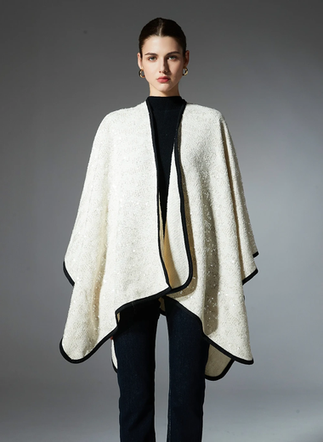
SHE BELIEVES presents custom development among its shawl and scarf services. Its Party Sequin Black Sparkly Shawl With Embroidery SHE-SY-010012 listing describes embroidered sequins, while another product page presents a solid-color sequined evening wrap. These are relevant product references, but neither public page defines the stitch route, thread, or project pull value for a future custom lot.
Those project details can be addressed through the ODM and OEM service. A useful development brief links the motif drawing to the areas most likely to snag, the care and packing route, and the proposed method. The actual sample construction then remains the approval reference instead of an assumption made from a website image.
Conclusion
The central question is how a defect travels. Does one attachment contain it, does a shared thread carry it onward, or does the cloth fail before the stitch? The reverse face helps answer the first part; moving and snagging the motif under realistic contact helps answer the second. A point or area check built around that construction then gives the seasonal order a control that reflects the shawl rather than an unrelated force number.
FAQs
1. Is there one pull force that applies to every sequin shawl?
The construction decides what a meaningful force would be. A value only makes sense beside the sequin type, stitch route, base cloth, fixture, direction, and intended use.
2. Why inspect the reverse side?
That is where shared stitch paths, backing, lock points, and loose tails are easiest to follow. It also shows whether the cloth is opening around the stitch.
3. Why Might the Center of the Shawl Miss the Main Snag Risk?
Because the center often receives less edge contact and less handling. Include the motif transitions at edges, fringe, closures, folds, and moving zones when those features occur in the design.
4. Can packaging expose an attachment weakness?
Yes. Pressing decorated faces together and then pulling them apart during unpacking can catch a sequin or advance looseness along a shared thread while the flat packed unit still appears acceptable.


